
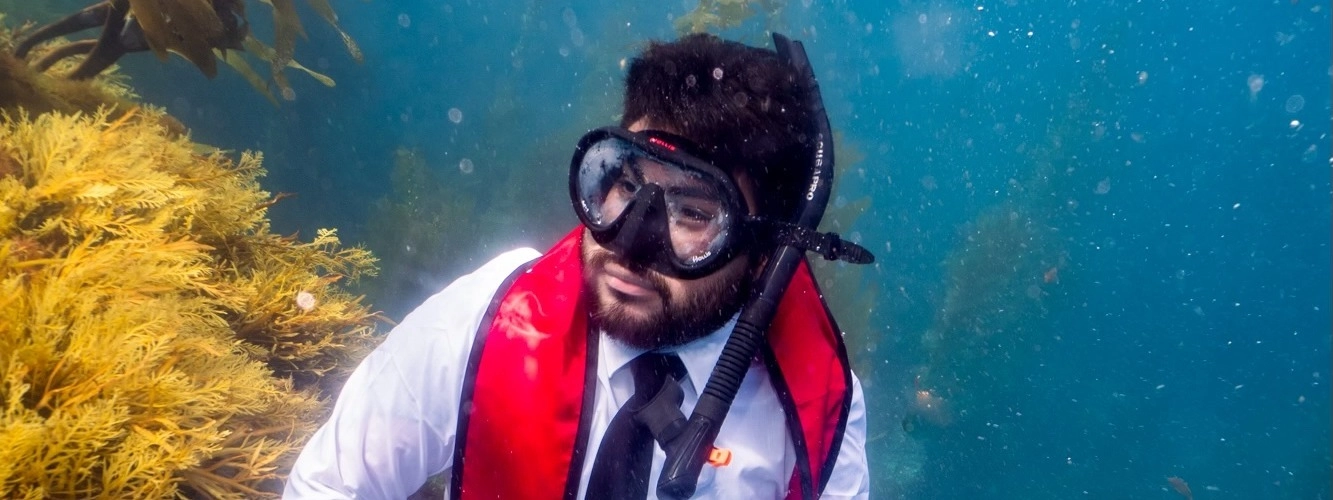
Alumni Spotlight, Isaac Torres (’26)
Marine biology graduate dives into a dream internship at the Monterey Bay Aquarium.
By Michael Klitzing
One day after San Diego State University’s commencement in May, Isaac Torres (’26) packed up a U-Haul and headed north. The biology major with an emphasis in ecology was making a hasty departure from his hometown of Chula Vista, California, and had just enough time to load up his mattress, desk, computer, some clothes and — of course — his personal dive equipment. “It was just crazy,” Torres says. “I remember there were friends and family saying, ‘What do you mean we’re not even going to be able to say goodbye to you?’”
But opportunity was knocking, and he had no time to waste. Torres was embarking on a six-month paid internship as a kelp forest scientific diver at the world-famous Monterey Bay Aquarium in Northern California. In collaboration with the University of California, Santa Cruz, his studies include why sea urchins overtake kelp forests. In the months since, his workplace has been a magical setting — one he likens to being beneath the canopy of a towering redwood forest, only underwater. This is something Torres has dreamed of doing ever since marine science captured his imagination while on family vacations on the coast of Baja California. “I can’t really put it into words,” he says. “I recently dove in the kelp forest exhibit at the aquarium while it was open, and I got to see all the little faces outside of the glass. It’s been amazing.”
Q: What do you remember about your time at SDSU?
“My experience started at Southwestern College where I got into the STEM Pathways program, which bridges the gap between community college students and SDSU. STEM Pathways allowed me to do research under Professor Kevin Hovel. That opened the door for me to everything that is marine science.”
Q: How did SDSU set you up for professional success?
“I think I made the best out of the two years at SDSU. I was able to go to both San Clemente and San Nicolas islands — two very restricted islands that not very many people get to even set foot on — to do black abalone research with Professor Jeremy Long. I also had the opportunity to work in the labs of professors Rebecca Lewison and Matt Edwards. I even got to go to Catalina Island to support [Edwards’] kelp forest restoration project. It was very surprising that I was able to do that much stuff. But honestly, it all came from just asking questions and showing professors that I’m interested.”
Q: What advice would you have for current students interested in following in your footsteps?
“One piece of advice that I’ve lived by is, ‘Don’t ever be afraid to ask for something.’ Ask for that position. Ask to be a volunteer. Ask the professor what they’re doing. It shows interest. Especially in science, all a professor wants is for you to be interested. If you can show that, then you’re all good.”